
"Chill Winds Still Blow": Sticky little leaves in The Brothers Karamazov
It's one *cool* poem!...👀


Contains no major spoilers.
Introduction
I recently came across a great translation of the famous Russian poem “Chill Winds Still Blow” by Alexander Pushkin which was not easy to find online, so I wanted to share it here in hopes it’ll be easier for others in the future.
For those who may not be familiar, the phrase “sticky little leaves” from the poem is referenced several times in one of the most important scenes in The Brothers Karamazov by Fyodor Dostoevsky, a monumental work on the nature of love and suffering. My main motivation is to synthesize my personal notes to better understand these allusions — in other words, I’m really just writing this for myself, but hopefully it’ll be interesting to you, too. Feel free to share your thoughts or questions in the comments.
This post is written in two parts:
I’ll share Pushkin’s poem and briefly go over it, so you don’t need to have read The Brothers Karamazov for this.
If you have read it, or are just curious, you can continue on where I trace references to “sticky little leaves” through Alyosha and Ivan’s discussions about joy, or you can just skip to the Conclusion. Although I assume prior knowledge of the book, most spoilers are avoided.
“Chill Winds Still Blow” by Pushkin
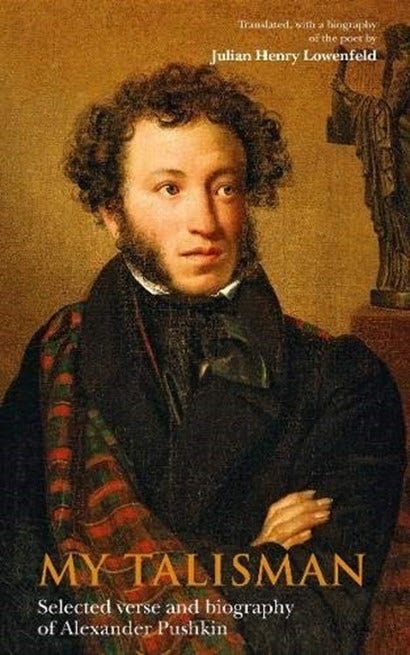
This translation is titled, “Winter’s chill blasts of wind are still blowing”, an excerpt from My Talisman, a collection of poems by Alexander Pushkin, translated by Julian Henry Lowenfeld. (The only other source I found is this more literal translation which also includes the original Russian, but I prefer this version.)
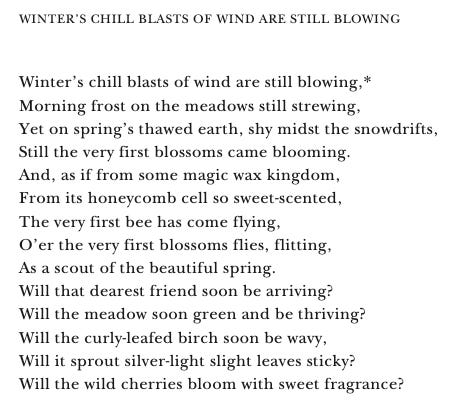
The footnote reads, “This is said to have been Fyodor Dostoyevsky’s favourite poem.”
Poem Overview
I’m admittedly a weak reader when it comes to poetry, so I’ll just briefly share my notes since I’m more interested in discussing The Brothers Karamazov.
The arrival of spring may be a common symbol of resurrection, hope, life, etc. but it is cleverly portrayed here. The chronological progression of the poem subtly reflects the transition from winter to spring, contrasting with the fact the entire scene takes place in a single winter morning, as if we’re gradually being drawn into the future:
Lines 1-2 are explicitly about winter’s cold,
Line 3 transitions from winter to spring,
And from line 4 onwards, there is absolutely no mention of winter anymore.
The narrator’s anticipation of renewal transfigures his very awareness of the present; for him, the chill winds vanish entirely. The repetition of “very first” on lines 7-8 link back to line 4, connecting the bee to the blossoms despite the distance in text. The introduction of the bee mirrors the arrival of spring — the narrator does not actually observe where the bee comes from, instead imagining a “magic wax kingdom”, connoting a sense of awe and mysticism appropriate for the wonder of nature.
The questions at the end involve the sensory descriptors “wavy”, “sticky”, and “sweet fragrance”, all of which precisely describe honey and the beehive — in fact, the honeycomb cell is explicitly described as “sweet-scented.” It’s clearly an intentional link, but frankly I’m not totally sure why. My best guess is that it’s about the abstract “essence” of nature, hinting at how the birch is a source of life for the bee, honey as a pure distillation of this essence which retains those invariant properties. And of course, the second to last line is the famous “sticky little leaves.”
Although there’s more to be said about rhyme and rhythm throughout the poem — for instance, the alliteration of “silver-light slight leaves sticky” — I won’t comment on them since I’m not sure how sounds and tone may or may not be preserved in translation. If anyone is able to read Russian, I would love to hear your thoughts on the original poem.
In The Brothers Karamazov
A couple points before we begin:
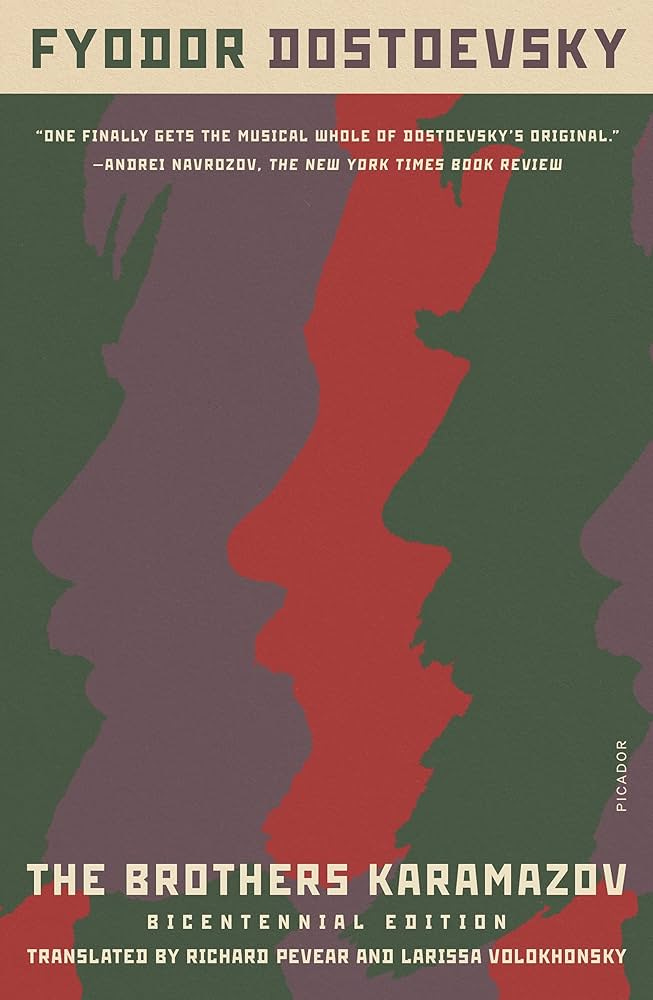
All page numbers are for the P&V translation.
Asterisks refer to topics that I will revisit in future posts and may retroactively add links, since the discussions here are far from exhaustive.
If you’re not that interested in reading the details, you can just skip to the Conclusion — I won’t be offended.
There are many religious themes across Dostoevsky’s works, so as someone who is not religious, nothing written here should be considered an endorsement or criticism of religion.
From the first mention
The “sticky little leaves” appear only a handful of times, first appearing in the chapter “The Brothers Get Acquainted”:
“Though I do not believe in the order of things, still the sticky little leaves that come out in the spring are dear to me, the blue sky is dear to me, some people are dear to me, whom one loves sometimes, would you believe it, without even knowing why; some human deeds are dear to me, which one has perhaps long ceased believing in, but still honors with one’s heart, out of old habit.” (p244)
This is the first scene where we (and Alyosha) properly get to know Ivan. Our introduction to him in Part 1 is filtered through Alyosha’s estrangement from him, leading us to share his anxious expectation of Ivan to be some condescending, rationalist skeptic ready to start arguing with the monks — however, much to everyone’s surprise, he was in fact the most well-behaved and respectful guest at the monastery. Though he is admittedly a cynical atheist (“Though I do not believe in the order of things…”), he genuinely harbors a deep love for life that he cherishes even if he doesn’t understand it, but this is precisely the source of his suffering. Ivan’s compassion for mankind may even rival Alyosha’s:
“The precious dead lie there, each stone over them speaks of such ardent past life, of such passionate faith in their deeds, their truth, their struggle, and their science, that I—this I know beforehand—will fall to the ground and kiss those stones and weep over them—being wholeheartedly convinced, at the same time, that it has all long been a graveyard and nothing more. And I will not weep from despair, but simply because I will be happy in my shed tears. I will be drunk with my own tenderness. Sticky spring leaves, the blue sky—I love them, that’s all! Such things you love not with your mind, not with logic, but with your insides, your guts, you love your first young strength…” (p245)
Just as how Zosima kisses the earth (p344), and how Alyosha weeps tears of joy as he embraces the ground (p384), Ivan will kiss and embrace the earth as he waters the graves with tears of tenderness. The similarities are telling, but the differences are even more striking. Alyosha kisses the ground after witnessing Zosima do it, and in his spiritual reawakening, parts of Zosima’s homily come flooding back to him — relatedly, Richard Pevear notes much of Alyosha’s dialogue consists of echoing the words of other characters. On the other hand, Ivan is not influenced by anyone (besides, arguably, Western ideologies), and he even precedes Alyosha and Zosima; in a sense, he demonstrates greater agency than Alyosha.
Unto ages of ages
Ivan uses the metaphor of a graveyard to describe Western Europe, which Dostoevsky has a roiling love-hate relationship with (mostly hate) due to the Westernization of Russia. A common theme across his works is how certain rationalist ideologies lead to moral degeneration and corruption of religion, but they are not only a necessary evil in understanding the nature of faith, they paradoxically cannot be resolved with free will, only the lack of it — and yet, a solution exists*. This is the cornerstone of the Grand Inquisitor’s condemnation of the Temptations of Christ and Ivan’s nightmare of the Devil. Across books, this can be found in Myshkin’s epilepsy in The Idiot, Raskolnikov’s dialectics in Crime and Punishment, and the entirety of Notes From Underground. To get to the point, Ivan is calling Western Europe spiritually dead. (Although some may disagree, I make the following distinction between spirituality and religion at least for the scope of my own writing: in short, Dostoevsky regards spirituality as not necessarily synonymous with religion but rather analogous to “being in touch with oneself” so to speak, or self-honesty.)
The juxtaposition of life (sticky little leaves) and death (the graveyard) transitions into:
“Half your work is done and acquired, Ivan: you love life. Now you need only apply yourself to the second half, and you are saved.”
“You’re already saving me, though maybe I wasn’t perishing. And what does this second half consist of?”
“Resurrecting your dead, who may never have died.” (p245)
Alyosha’s mention of resurrection is strangely abrupt and immediately abandoned, but we’ll revisit this later. It’s difficult to do this line justice without inadvertently reeling in the entire body of his works, as remembrance is tightly intertwined with many other themes. In The Idiot, beauty is an ineffable force which awakens Myshkin to the self-actualization, perfection, and emptiness — some may recognize this as “divinity” — dormant in nature which, cruelly, forever lies beyond his comprehension:

Similarly, memory is the mechanism which awakens characters to morality and rouses compassion in moments of profound suffering that transcend logic. The novel even begins with Alyosha’s earliest memory of his weeping mother, which is implied to have compelled him to enter the monastery after her death, and ends with his homily on remembrance:
“You must know that there is nothing higher, or stronger, or sounder, or more useful afterwards in life, than some good memory…If a man stores up many such memories to take into life, then he is saved for his whole life. And even if only one good memory remains with us in our hearts, that alone may serve some day for our salvation.” (p821)
For Alyosha, memory is ignited by suffering and sustains him through it. On the other hand, Ivan acknowledges that although his burning passion shields him from “all the horrors of human disillusionment”, it’s only a matter of time before he succumbs to existential suffering: “I just want to drag on until I’m thirty, and then—smash the cup on the floor!” (p279). After hearing Ivan’s poem of the Grand Inquisitor, Alyosha fears for him:
“And the sticky little leaves, and the precious graves, and the blue sky, and the woman you love! How will you live, what will you love them with? ... Is it possible, with such hell in your heart and in your head? No, you’re precisely going in order to join them … and if not, you’ll kill yourself, you won’t endure it!” (p279)
Just as how the Grand Inquisitor disavows Jesus’ kiss, Ivan renounces his ability to love life in an act of “Rebellion”, of self-destruction. If you’ve happened to have read the short story “The Ones Who Walk Away from Omelas” by Ursula K. Le Guin, this is the exact same concept — fun fact, Ivan quite literally describes the entire plot in a single sentence (p261).
Conclusion
Pushkin’s poem is a straightforward message about spiritual resurrection, how hope manifested in the coming spring makes bearable our present suffering, but Ivan disagrees. This is made clear in his infamous line about atheism:
“Besides, they have put too high a price on harmony; we can’t afford to pay so much for admission. And therefore I hasten to return my ticket.” (p261)
The “ticket” is a reference to the poem “Resignation” by Friedrich Schiller* — in short, it is about the loss of faith, the mockery of religion by the material sacrifices made for immaterial reward, yet hidden in disillusionment is a glimpse of true faith, which ironically only adds to the mockery. In the end, the speaker acknowledges that hope in an afterlife and earthly pleasure to numb suffering are mutually exclusive. Nevertheless, he chooses faith, knowing that although it must be its own reward, there remains doubt whether it can compensate for what is lost in life. Some of you may recognize this as the premise for Ivan’s dialectics around theodicy and the Grand Inquisitor.
In a departure from Pushkin, Dostoevsky believes there is something even stronger than unsubstantiated hope for the future: past memories of love. Just as how Alyosha’s memory of Zosima saves him from a moment of self-destruction, or how Marcel Proust describes in In Search of Lost Time the resurrection of his hometown in the taste of the madeleine, or the torment of denying one’s past in Kazuo Ishiguro’s The Remains of the Day, memory is a near-omnipotent force which transfigures consciousness and cannot be resisted*.
Earlier, in response to Ivan’s admission of how he is headed to a “graveyard” of spiritual death, Alyosha remarks that the nature of joy lies in two parts: loving life beyond all meaning, and “resurrecting your dead, who may never have died.” His cryptic line about remembrance contains a second meaning: those “who may never have died” are, in fact, the living. Alyosha refers to those who are spiritually dead, having surrendered life and resigned to suffering, unable to show compassion for others and, therefore, themselves. This is seen in Lise’s dream of eating pineapple compote as she watches a boy being tortured, or in Crime and Punishment when Raskolnikov recognizes his inner death mirrored in Sonya. Zosima’s final homily emphasizes the interconnectedness of humanity — in the same way that memory is a transformative force for oneself, acts of unconditional love are a transformative force for others.
Richard Pevear in his Forward to Notes From Underground writes:
Inner movement...is always a condition of spiritual good, though it may also be a source of suffering, division, disharmony, in this life. What moves may always rise.
Across all of Dostoevsky’s works, characters are stirred to action by compassion amidst suffering; the sublime terror of death; and above all, the self-effacement of receiving a love you feel you don’t deserve, all of which culminate beautifully in Alyosha’s kiss of resurrection:
“So, Alyosha,” Ivan spoke in a firm voice, “if, indeed, I hold out for the sticky little leaves, I shall love them only remembering you.”
I just spent an hour trying to track down a published English translation of the poem in BK with Ivan's "sticky little leaves opening in spring", and finally ended up here. I had to search for the poem in Russian; then for a published English source; THEN I had to tell Google's AI that it had given me the wrong poem. FINALLY it lead me to this Substack post(!) Thanks for posting this.
And WHY do we track down these things? Well, besides being a cool poem (yes!), Dostoyevsky might have the full poem in mind when he has Ivan quote it (twice!). Could it possibly add to the meaning of what Ivan says, feels and thinks? 🧐
Also, the botanist in me was curious as to whether there were any clues about which actual leaves are sticky. However, it sounds like these are crocuses or something that pop up through the holes in the ice during the beginning of spring thaw. I confess I've never investigated whether crocus leaves are sticky (or, indeed, whether there is an even more northern spring plant that appears first in Russia.) The word for "sticky" in Russian indeed means sticky, but Wiktionary also translates it as "tenacious".
So I guess AI isn't all bad since it finally got me here. Plus, we know that Google continuously trains its AI, since this post was written only three months ago. (But only on content published online I guess.) I'm learning to respect AI as a search mechanism. Not interested in its interpretations, however(!)